
LLM Primer
LLMs for Research Administration: An AI Primer for Professionals

Unlock the power of Large Language Models (LLMs) in research administration. Learn how AI streamlines tasks, enhances compliance, and boosts productivity for research professionals.
Topics: LLM Research Administration, AI for research administrators, large language models in research, research administration AI tools
Introduction
When it comes to the future of research, artificial intelligence (or AI) is as hot as topics can get. To start off, we’ll dive right into the most relevant subset of AI, Large Language Models, which we’ll refer to as “LLMs.” These LLMs are our most basic, futuristic toolbox to use to streamline research tasks, with capacities such as text generation, translation, and question-answering. When used properly, LLMs can serve as a highly intelligent assistant that will work tirelessly to boost your productivity.
Understanding Large Language Models (LLMs) for Research
Large Language Models (LLMs) are artificial intelligence systems trained on vast amounts of text data to understand and generate human-like language. They have been a revelation, even compared to previous AI systems because of their broad utility. Traditional AI systems- and traditional software systems more broadly- relied on rule-based programming that led them to be very good at accomplishing very specific responsibilities. The chatbots we have today aren’t just glorified search engines either! Search engines (like Google Search) retrieve information that already exists on the internet, while these LLM-powered chatbots are “generative,” meaning that they can not only find information but can create new content and accomplish various duties. The tech we’ll be discussing today has been a work in progress since the dawn of the internet age, but the breakthrough came via Google research in 2017 with the "Attention Is All You Need” publication. Groundbreaking technology published in that set the stage for the release of the GPT-1 model in 2018, which led to the public launch of OpenAI’s ChatGPT in 2022. Since then, these LLM-backed chatbots have become the most quickly adopted technology in history, with competitors such as Google’s Gemini and Anthropic’s Claude chatbots coming shortly after. These models are “trained” on vast text data, where between billions and trillions of words are fed through from a diverse array of sources. This allows the models to develop a sophisticated understanding of meaning, and that understanding is what allows for the revolutionary capacity of the tools that can help us today!
Practical Applications of LLMs in Research Administration
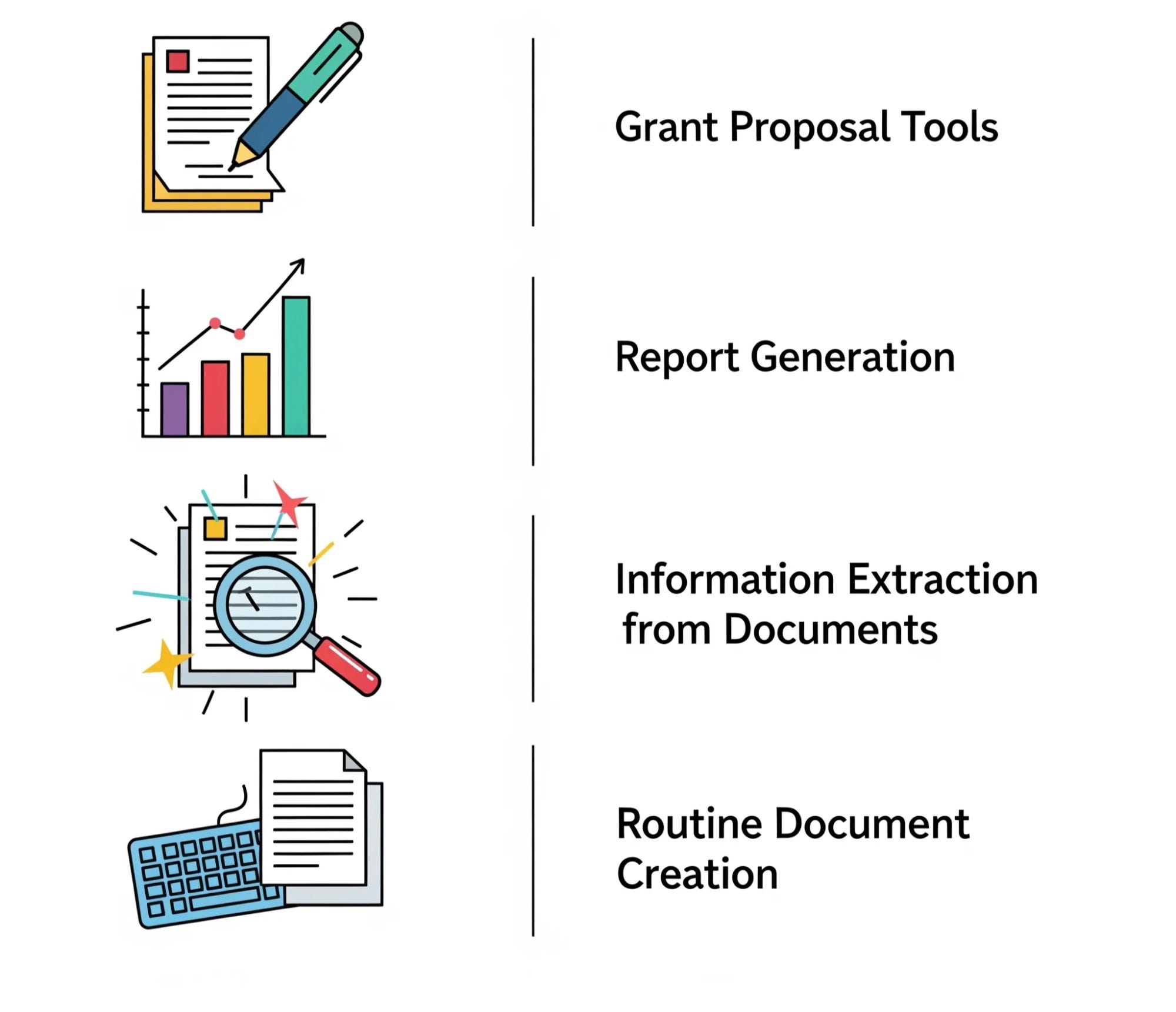
Generative AI is a gamechanger for research. With intelligent usage, grant proposal AI tools can make proposal-craft a breeze. Additionally, reports can be largely written for you, and summaries of complex topics can be provided automatically. A specific arena in which AI can be a massive timesaver is in pulling information from complex documents (like NOFOs and solicitations). With AI, an administrator can now just ask for information from the document they’re interested in and get a direct answer, and if the information is still unclear, chatbots can give specific advice and further resources. Routine document creation is another one of the biggest time sinks in research administration today, and it’s safe to say that it’s rarely the highlight of an employee’s day. Thankfully, AI excels at routine paperwork. For example, by providing desired parameters, we can get AI tools to draft compliance reports in seconds. On a central office level, compliance monitoring AI can act as an intelligent compliance monitor that doesn’t take nights and weekends off. With today’s AI tools and a little bit of ingenuity, we can not only ensure faster work but safer work.
Top LLM and AI Tools for Research Administrators
There are a variety of chatbots based on the newest LLM developments that can come in handy for research professionals. The most popular of which is certainly OpenAI’s generative AI chatbot, ChatGPT. ChatGPT has various different versions of itself, all with different capabilities. While certainly not an exhaustive list, other competitors include Anthropic’s Claude and Google’s Gemini, all of which have their own styles and strengths. As these change with every update, it’s best to just try them all out and see what works best for your workstyle. Some institutions will have licenses which allow individuals to take advantage of premium features, which can also certainly help as a decision-making tool.
Responsible LLM Adoption in Research
There is an ever-expanding field of knowledge surrounding LLMs, AI, and research administration, and we’ve only yet scratched the surface. By learning more about how this emerging technology works and how to responsibly adopt it, research organizations can position themselves for future advancement as the tech itself improves. AI is novel, as it can teach you about itself. With no delay, most questions you may have about interacting with AI can be answered by interacting with the AI: just ask the LLM chatbot of your choice! For a human touch, we’ll be here at the Modern Research blog, providing more helpful information every week, and we hope to have you along.
Have you incorporated AI into your workplace? Has your organization led any rollout of new research administration tools recently? Is there anything more you’d like us to cover going forward? Let us know in the comments!